Curriculum
Pooraka Primary School – The South Australian Curriculum for Public Education
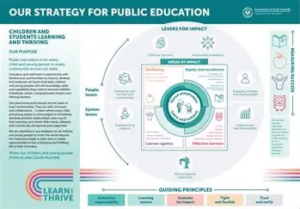
At Pooraka Primary School, we use the South Australian Curriculum for public education. This is a tailored adaptation of the Australian Curriculum Version 9, designed to address the specific needs and priorities of South Australian public schools. It provides a robust framework for implementing the national curriculum while reflecting the Department for Education’s strategy and four key areas of impact.
This curriculum empowers students with the knowledge, dispositions, and capabilities necessary to thrive in a rapidly changing world.
Visit curriculum in South Australia for more information.
South Australian Curriculum
SA Curriculum
This curriculum is an adaptation of the Australian Curriculum, tailored to meet the unique needs of our students here in South Australia. Along with our colleagues across the state, we are in the exploratory phase of using this curriculum. Here are some key points regarding the SA Curriculum:
1. Essential Learning Areas
The curriculum covers a broad range of subjects, including English, Mathematics, Science, Humanities and Social Sciences, The Arts, Technologies, Health and Physical Education, and Languages. Each area is designed to build foundational skills and knowledge, preparing students for future learning and life.
2. Capabilities and Dispositions
Beyond traditional subjects, the curriculum emphasises the development of general capabilities such as critical thinking, creativity, and ethical understanding. It also focuses on fostering positive dispositions like resilience, curiosity, and collaboration. These skills are essential for students to thrive in a rapidly changing world.
3. Learning Standards
The curriculum sets clear learning standards for each year level, ensuring that all students have the opportunity to achieve their best. These standards guide teachers in planning lessons that are both challenging and supportive, catering to the diverse needs of our students.
4. Engaging and Relevant Content
The curriculum includes contemporary and relevant content that connects with students’ lives and interests. This approach helps to make learning more engaging and meaningful, encouraging students to explore and discover new ideas.
5. Support for All Learners
We are committed to providing an inclusive education that supports all learners, including those with diverse backgrounds and abilities. The curriculum offers flexibility and resources to help teachers differentiate instruction and meet the individual needs of each student.
Literacy/English
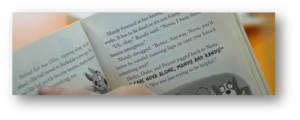
In our Early Years, we use a systematic synthetic phonics approach using the Department for Education’s R-2 ‘Phonics and Spelling Scope and Sequence’. We teach an evidence-based whole-class literacy program providing all children with the essential core knowledge and strong foundations to become successful readers and writers.
More about our program
Our program incorporates daily lessons in phonemic awareness, reading and spelling as well as rich language instruction using children’s literature.
Our program incorporates the key components necessary for early reading instruction – phonemic awareness, phonics, fluency, vocabulary and comprehension.
Our teachers use this approach to systematically and explicitly teach the alphabetic code in a set sequence. In addition to learning letter-sound correspondences and how these are applied to reading and spelling, children are introduced to common morphemes and simple grammatical concepts.
At Pooraka Primary School, we use the Department for Education’s R-2 Phonics Scope and Sequence, which aligns with the range of decodable texts commonly found in South Australian schools. It includes:
- reception, year 1 and year 2 phoneme-grapheme (sound-letter) correspondence tables with flexible boundaries between year levels
- continual revision of previously taught phoneme-grapheme correspondences
- recommended stop and check points to monitor student growth and effectiveness of tier 1 instruction
- prompt words, instructional information and word examples for reading and spelling
- guidance for teaching morphology
In Years 3-6, we use the Department for Education’s Spelling and Morphology Scope and Sequence.
The benefits of Pooraka Primary School P-6 implementing a systematic synthetic phonics program ensure that our staff teach single letters, common letter combinations and the sounds they represent in a discrete, systematic and explicit way. Research indicates this is the most effective approach to learning phonics. It supports students to:
- understand the relationship between sounds (phonemes), letters (graphemes) and letter combinations
- practice segmenting and blending letter-sounds to read and spell words
- expand their vocabulary
- decode text fluently
- use their letter-sound knowledge to write.
Keeping Safe: Child Protection Curriculum
The Keeping Safe: Child Protection Curriculum (KS:CPC) is required for all children and young people in our school. It’s taught each year by teachers who have completed a full-day KS:CPC training course.
It teaches children to:
- recognise abuse and tell a trusted adult about it
- understand what touching is appropriate and inappropriate
- understand ways of keeping themselves safe.
Visit Keeping Safe: Child Protection Curriculum information for parents and carers for more information.
Mathematics
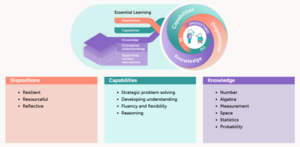
The foundation of our Mathematics curriculum is based on 3 core dispositions of learning, that students can develop. These are:
Resilient – not giving up; trying new ways of doing things
Resourceful – Developing strategies for understanding yourself as a learner and how to support your personal learning
Reflective – The ability to reflect back on your learning and work; refine it, and be able to talk about what learning was done well and why and what learning requires some modifications.